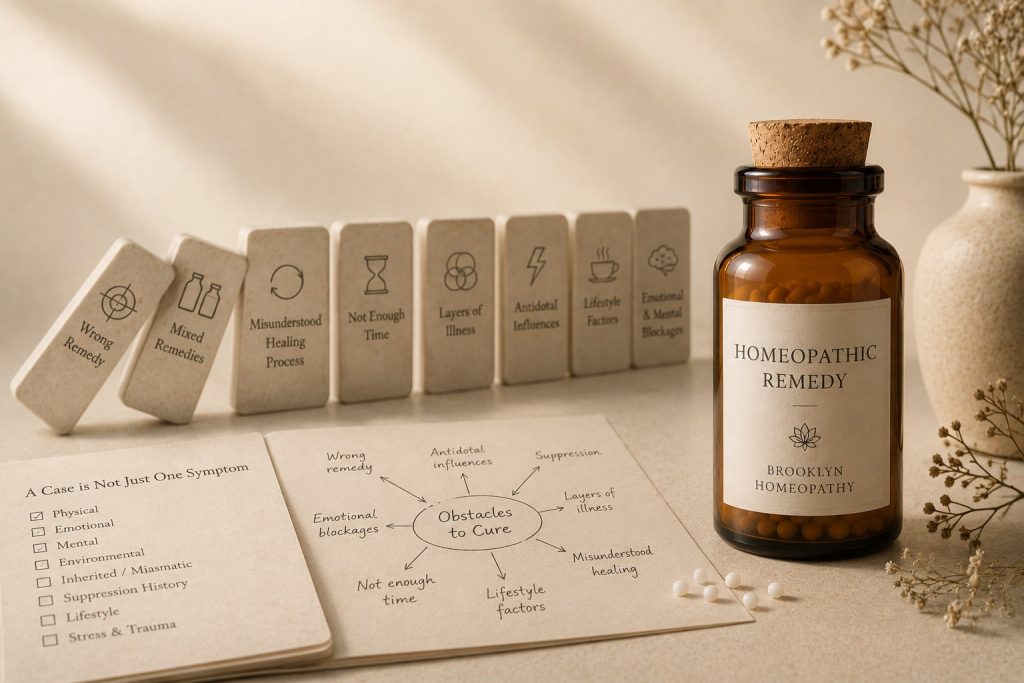

The Symptom is not the problem
In our modern, materialist culture, we have been trained to treat the human body like a machine. When a part squeaks, hurts, or fails to function, conventional medicine labels that localized symptom as the “illness” itself. We take a pill to suppress the pain, a chemical or supplement to override the exhaustion, or a steroid to quiet the inflammation, congratulating ourselves on “fixing” the malfunction.
But homeopathic medicine poses a radical challenge to this reductionist worldview: What if the symptom is not a malfunction at all? What if it is the body’s highly intelligent, beautifully coordinated defense mechanism shielding your deepest core from collapse?
An extraordinary story about the great authority on Jewish law, Rabbi Moshe Feinstein, illustrates this energetic reality with stunning precision.
The Story on the Sofa
Rav Moshe had no secretary to shield him from the public. Anyone could walk into his study hall to ask a question, and if the yeshivah payphone rang, he would walk across the room to answer someone in need.
One day, a visiting rabbi arrived at Rav Moshe’s home at an appointed hour. Rav Moshe’s wife stopped him at the door, apologizing that her husband was far too ill to receive visitors. Hearing a weak voice from the other room, the visitor was invited inside.
To his horror, the impeccably formal Rav Moshe was lying stretched out on the sofa, physically incapacitated and unable even to lift his head. “I am terribly ill,” Rav Moshe explained. “I just had an experience that left me without strength. I just went through a terrible episode. It has been years since I experienced such anguish.”
The visitor assumed the elderly sage had suffered a fall, a physical tremor, or a sudden cardiovascular event. But the cause was not physical at all. Rav Moshe explained that he had just been forced to adjudicate a case in which he believed another rabbi had acted with personal bias. To protect the integrity of the law, Rav Moshe had to make his opinion clear: the rabbi had to withdraw his ruling.
“I had to insult a Jew,” Rav Moshe said, devastated. “I had to. I couldn’t help it. I had to.”
To Rav Moshe, a soul of extraordinary gentleness, causing pain to another person was an emotional and spiritual shock of enormous magnitude. That anguish was immediately followed by a sudden and complete collapse of his physical strength.
Somatization: The Body’s Ultimate Defense Strategy
To a conventional physician, a physical complaint is often treated as an isolated problem. But biologically the human body does not function in separate silos. It operates as an integrated whole across three interconnected and deeply synchronized planes: the mental, the emotional, and the physical.
At the center are our reason, coherence, consciousness, and ability to understand reality. Closely connected are our emotions, our capacity to love, and our desire to engage with life. The physical body forms the more peripheral level through which many disturbances can be expressed.
These planes do not function independently. A fright can cause trembling. Grief can remove the appetite. Embarrassment can redden the face. Anxiety can produce diarrhea, heart palpitations, or sleeplessness. We instinctively recognize these connections, yet when illness appears, we often forget to ask what may have preceded it.
From a homeopathic perspective, the organism’s defense mechanism continually attempts to preserve the most essential levels of human functioning. When an overwhelming stressor, like a profound emotional trauma, shocks the system, the organism faces a critical threat. If the trauma remains locked inside the delicate limbic or cognitive center, it risks causing a permanent psychiatric break or complete cognitive collapse. To prevent this central catastrophe, the body employs a brilliant biological safety-valve strategy called somatization. The vital force acts like an electrical surge protector, transferring the destructive energetic charge outward and downward, away from the brain, and grounding it into the physical body.
This gives us insight into what Rav Moshe Feinstein intuitively understood about his sudden collapse. The anguish of having hurt another Jew struck him at the deepest point of his sensitivity. His loss of physical strength was not random or disconnected from what had occurred. It was the physical expression of profound emotional and spiritual pain.
The Law of Susceptibility: Why This Person, Why Now?
This raises an essential question: Why can two people experience the same event and react completely differently?
Classical homeopathy teaches the principle of susceptibility. Every person has particular areas of strength and particular areas of vulnerability, shaped by constitution, inherited predispositions, previous experiences, and overall level of health.
One person may be especially sensitive to rejection. Another may be deeply affected by humiliation, injustice, grief, fear, disappointment, or loss of control. Under strain, one person develops migraines, another experiences digestive problems, another breaks out in eczema, and another cannot sleep. The event alone does not determine the reaction. The event meets the individual.
Another person might have experienced Rav Moshe’s confrontation as unpleasant but remained physically unaffected. For Rav Moshe, whose character was defined by humility, compassion, and extreme sensitivity to another person’s pain, the experience struck with extraordinary force. His reaction reflected the meeting point between the event and his unique susceptibility.
This is why a homeopath does not ask only: What symptom does this person have?
We also ask: Why did this particular person develop this particular symptom at this particular time?
The Danger of Silencing the Signal
When a physical symptom appears, our immediate instinct is usually to make it disappear. Sometimes symptom relief is necessary and humane temporarily, but relief and cure are not the same thing. If we force a symptom to disappear without understanding the disturbance producing it, we mistake silence for healing.
A smoke alarm is loud, disruptive, and unpleasant. But the alarm itself is not the fire. Removing its battery might restore peace to the room, yet the problem that triggered it could still be burning.
A physical symptom can function in much the same way. Pain, fatigue, inflammation, fever, or an eruption may be the visible expression of the organism responding to something deeper. If we focus exclusively on silencing that expression, we lose the opportunity to understand what the body is communicating. This is what is known as suppression: the forced disappearance of symptoms without a corresponding improvement in the person’s overall health.
The concern is not simply whether one symptom is gone, but whether the person is becoming healthier as a whole by addressing the underlying root cause. Is the person experiencing greater energy, clarity, emotional stability, and freedom? Or has one symptom disappeared while deeper or more serious problems have emerged?
True Healing Begins with a Better Question
Rav Moshe’s story serves as a profound parable for everyone seeking true health. When we face a physical ailment, we must stop asking: “How can I make this symptom go away as fast as possible?”
Instead, we must have the humility and insight to ask:
- What happened before this symptom began?
- What disturbance might the organism be responding to?
- Why did it affect this person so deeply?
- Why did the response take this particular physical form?
- Will my treatment silence the signal or strengthen the person as a whole.
The symptom is never the whole sickness. Like a wailing smoke alarm, it may be the signal alerting us to a deeper disturbance. True healing does not mean ignoring symptoms or refusing necessary medical care. It means respecting symptoms as meaningful information and seeking to understand the person who is experiencing them.
How Homeopathy Addresses the Root
The human organism is intelligent, but it does not always have the strength to overcome a sudden shock or deeply established chronic imbalance on its own. Recurring symptoms may indicate that the defense mechanism continues trying to restore equilibrium but cannot complete the process.
This is where classical homeopathy enters.
Rather than selecting treatment from the diagnosis alone, a classical homeopath studies the patient’s complete symptom picture: what changed, when it changed, what preceded it, where the person is most sensitive, and how the disturbance has expressed itself mentally, emotionally, and physically.
The goal is to find the simillimum, the individualized homeopathic remedy that most closely corresponds to the person’s total state. The remedy is intended to stimulate the organism’s own defense mechanism so that healing can proceed from within, rather than simply forcing an isolated symptom to disappear.
The Choice: A Band-Aid or True Freedom?
If you are tired of merely managing your chronic symptoms, chasing temporary relief, or patching chemical deficiencies with lifelong supplements and drugs, it is time to look deeper. True health is not a state of perpetual chemical or supplement dependency, and it is not defined by the disappearance of one symptom. It is reflected in greater freedom and stability on every level: mental, emotional, and physical.
Classical homeopathy honors the profound intelligence of your organism. It does not view the body’s warnings as meaningless malfunctions. It seeks to understand why the alarm began sounding, what it reveals about the individual, and what the person needs in order to regain balance.
The goal is not merely to silence the alarm.
The goal is to find and address the fire.
Step off the endless treadmill of symptom-chasing and choose a path of genuine, dynamic healing that returns your vital force to its natural, self-sustaining state of equilibrium.
The story of Rav Moshe Feinstein was adapted from “The Pain Rabbi Moshe Feinstein Could Not Ignore,” written by Dovid Zaklikowski for Hasidic Archives and published by COLlive.